


Early Education (PreK3-PreK4)
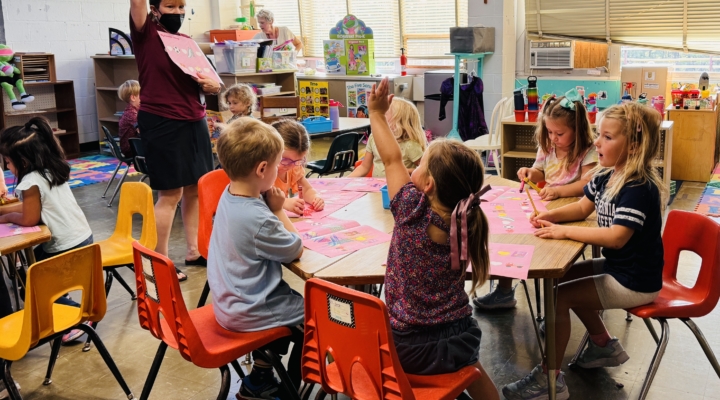
The underlying instructional strategy in early education throughout preschool is the use of organized and free-play activities that are intended to provide opportunities for the child to interact, explore and relate successfully in his/her environment.
Located on our first floor, the preschool program uses multi-sensory hands on learning approach to teach fine motor skills, auditory and visual learning using center time, books, songs, technology, and art. Free play, story time, show and tell, music, crafts, and outdoor play fill the students’ day. Children attend prayer services, participate in community service projects and are provided many cultural arts activities.
Parents are confident in knowing their children are being educated in a comfortable and nurturing environment which provides an educational curriculum that allows children to achieve their highest potential.
Subject Areas
Religion
The Religion curriculum is designed to give students an introduction to core Catholic beliefs, guide them in forming their Catholic identity, and model Christian Living for them in real and applicable ways. The Archdiocese of Baltimore Religion curriculum provides students with the initial experience in a formal Religion class offered by our Catholic schools. The focus of the course is on the basic foundations of our Catholic faith and similar to all other Religion courses, there is a year-long focus on Prayer, Service, and the Liturgical Year. The first half of the year introduces students to essential components to our faith, such as God, the Bible, the creation story, and the Sacraments. The second half focuses on the life of Jesus and the body of the Church as well as how our faith impacts our lives.
- Students learn to recite the Sign of the Cross and to genuflect.
- Students learn to recite simple prayers.
- Students identify a rosary and learn how to use it.
- Students learn that the Church has different seasons.
- Students learn about the Holy Trinity.
- Students learn the Creation Story and that they were made by God out of love.
- Students identify Mary as Jesus’s mother.
- Students learn about the saints and angels as God’s special messengers.
- Students learn that they are called to serve God.
- Students learn the story of Jesus’ birth.
- Students learn that the Bible is a special gift from God.
- Students learn about the Old and New Testaments. They engage in Bible stories.
- Students learn about the physical attributes of the Church as well as the fact that the Church is composed of God’s followers.
- Students learn about the Mass.
- Students learn about the Sacraments.
- Students recognize Jesus as the Good Shepherd.
- Students learn that Jesus died and rose again to save us.
- Students learn to love as Jesus loves.
- Students explore concepts such as friendship, morality, kindness, respect, service, and the difference between right and wrong.
Mathematics
The early childhood math curriculum for all elementary schools in the Archdiocese of Baltimore includes the following units:
- Counting and Cardinality
- Measurement and Data
- Geometry
- Numbers and Operations
Catholic educators never forget that our schools exist to bring our students to Christ. By continuing to implement new standards that are challenging, we work to fulfill the promise of quality Catholic education that educates the whole child, both mind and soul. By the completion of preschool, students will master a variety of skills, including:
- Count, recognize, and represent numbers 0–10 using objects, pictures, and numerals.
- Understand the relationship between numbers and quantities, including one more and one less.
- Count objects accurately and recognize small groups of objects without counting (subitizing).
- Compare groups of objects and determine whether one group has more, less, or the same number as another.
- Identify, describe, sort, and compare 2D and 3D shapes based on their attributes.
- Build and describe structures using shapes and positional words such as above, below, next to, in front of, and behind.
- Measure and compare objects by length, height, weight, volume, temperature, and time.
- Sort, organize, and analyze data using categories, simple graphs, tables, and coin attributes.
- Recognize, extend, and create repeating patterns such as AB, ABC, AABB, and ABBA.
- Explore addition and subtraction within 5 by combining, separating, and breaking apart numbers using objects, drawings, and real-world situations.
English Language Arts
The early childhood English Language Arts Curriculum for the Archdiocese of Baltimore is designed to prepare students for Kindergarten and give them a strong foundation in early literacy skills. Encompassing the Maryland Standards of Learning, the curriculum addresses all areas of early literacy: phonics, phonemic awareness, writing, speaking, immersion in books, and concepts of print.
- Students gain an understanding of print.
- Students engage with a variety of texts.
- Students work on phonemic awareness.
- Students learn to engage appropriately in group discussions.
- Students begin to recognize their names.
- Students practice following directions.
- Students begin to understand upper and lower case letters.
- Students begin to recognize the parts of a book.
- Students begin to recognize letter sounds.
- Students begin to represent ideas on paper.
- Students begin to match letters with sounds.
- Students begin to recognize and repeat rhymes.
- Students practice the concept of retelling and prediction.
- Students identify character strengths.
- Students model appropriate grip.
- Students recall details from texts.
- Students form letters with a variety of tactile materials.
- Students follow three-step directions.
- Students work on gathering and sharing information.
Science
The early childhood science curriculum is written to inspire in students an interest in nature, science, engineering, and caring for the earth.
- Students will learn about seasons, weather, body parts, and some scientific tools.
- Students will learn how scientists gather information.
- Students will explore fall.
- Students will identify and utilize the five senses.
- Students will identify the seasons of the year.
- Students will actively engage with nature.
- Students will identify what things are made of, how things work, and what tools to use when exploring what things are made of.
- Students will explore properties of water.
- Students will explore ramps and what things will roll.
- Students will explore spring.
- Students will learn about eggs, seeds, insects, and plants.
- Students will learn about how to take care of the Earth.
- Students will learn about animal habitats, needs, homes, and skin coverings.
- Students will compare how animals are alike and different.
Social Studies
The early childhood social studies curriculum is written to show students their place in the world. It is designed to give them important skills in moving forward, including mapping, understanding history and time, and discovering their own gifts and talents. Encompassing the Maryland Standards of Learning, the curriculum prepares students in the areas of geography, history, and cultural diversity.
- Students will gain a better concept of time in terms of the chronology of a calendar and what happened in the past vs. now.
- Students will identify ways different groups of people celebrate different holidays.
- Students will identify and practice social justice and equity.
- Students will learn the importance of rules and how to be a good citizen.
- Students learn to recognize their "safe people" and the Emergency Number.
- Students will explore concepts of freedom and equality.
- Students will discover what makes them special and unique while celebrating that everyone is different and special.
- Students will learn to appreciate that we all have different perspectives and opinions.
- Students will focus on mapping skills and where we are in the world.
- Students will explore ways of getting from one place to another.
- Students will explore their own sense of self within their school community, larger community, country, and world.
- Students will explore jobs, careers, helpers, goods, and services.
- Students will explore trade as well as the concept of limited resources.
Additional Subject Areas
- Fine Arts
- Physical Education/Health
- World Languages